

In this post, I’ll break down TEF Canada Speaking Section B and the most efficient way to prepare for the ‘Convince Your Friend’ role-play.
Section B is still a role-play: it’s interactive and based on a short everyday document. However, the goal changes completely.
What Section B Is
The TEF oral expression test is a face-to-face exchange with an examiner and has two sections:
-
- Section A (5 minutes): obtain information (i.e., you ask questions)
-
- Section B (10 minutes): argue to convince (i.e., you persuade)
In Section B, you receive an everyday advertisement/announcement (job offer, service, leisure activity, public announcement, etc.). Your task is to:
-
- present the document clearly
-
- argue to convince your interlocutor to participate in the situation described
The examiner plays the role of your friend, so the conversation is meant to be informal compared to Section A.
Informal conversation = tutoiement
Document Types?
You don’t need to overthink “this document is only for A” vs. “only for B.” In official examples, both sections use similar document types (ads/announcements from daily life). What changes is your objective: ask in A, persuade in B.
The Biggest Mindset Shift: You’re Not Judged on “Winning”
A lot of candidates (including me at the beginning) believe:
“If my friend says yes at the end, I did well. If not, tant pis.”
However, here’s the key: for the purpose of the exercise, you’re evaluated on your ability to:
-
- present a situation
-
- develop and clarify your ideas
-
- maintain a natural, informal interaction
-
- react appropriately to the examiner’s interventions
This also means you should not get discouraged if the examiner pushes back a lot. Pushback is normal—and sometimes it’s literally the point of the task.
The examiner may be more or less challenging depending on how often they object or interrupt. But your performance is evaluated using a standardized grid, and the oral test is recorded for double evaluation.
Here’s the most useful preparation idea (and I still stand by it):
Common Objection Categories
Unlike Section A, in Section B, grouping ads is not as important. What you need for Section B is reliable counter-arguments for the objections that come up again and again.
From my own test experience, objections usually fall into a few predictable buckets:
-
- Time: “I don’t have time right now.”
-
- Money: “It’s expensive / not worth the cost.”
-
- Distance / logistics: “It’s far / no car / inconvenient schedule.”
-
- Experience level: “I’ve never done that / I’m not good at it.”
-
- Personality / comfort: “I’m introverted / shy.”
-
- Interest: “I’m not interested / I don’t like that kind of activity.”
-
- Risk / uncertainty: “What if it’s bad? What if we don’t like it?”
The Simple Counter-Argument Formula
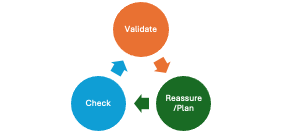
When your friend objects, don’t jump straight into arguing. Use this 4-step loop:
-
- Validate (show you understand)
-
- Reassure (reduce worry by addressing the risk, uncertainty, or concern directly)
-
- Plan (offer a clear next step)
-
- Check (ask for feedback or agreement)
Example
-
- “I get it—you’re busy.”
-
- “That said, it’s only one short session, and we can choose a flexible time.”
-
- “Let’s try it once, and if you don’t like it, we stop.”
-
- “How does that sound?”
And if this complicates your prep, you can combine steps 2 + 3:
-
- “I see what you mean.”
-
- “That’s why …”
-
- “What do you think?”
This structure helps you stay calm when the examiner changes objections quickly.
If You Repeat Yourself in Section B, Don’t Panic
When you’re speaking French, your mental energy is split between producing French and inventing ideas in real time—so repetition happens, especially when you’re running out of ideas.
Here’s the practical rule I recommend:
-
- If you repeat a sentence once: let it go and keep moving.
-
- If you feel yourself repeating the same argument again: switch strategy.
What Works Better Than Paraphrasing the Same Idea
Paraphrasing helps, but it’s even stronger to have a second angle prepared—and that’s what you need to prepare in advance.
Example: your friend says, “It’s expensive.”
-
- Angle 1: cost vs. value (benefits)
-
- Angle 2: cheaper alternative / discount / shared cost
-
- Angle 3: long-term return (skills, experience, health, etc.)
In my first two attempts, I caught myself repeating the same counter-argument. Often, the better angle came to me only after I had already moved on. And even if you’re familiar with the topic/advertisement, it can be much more difficult to come up with new ideas under stress.
If French isn’t your mother tongue like myself, “finding an idea” can be a huge mental load. So having 2–3 angles per objection makes you much more flexible and gives you room to respond without freezing. As you practice, your job is mainly to hunt for new, plausible angles.
Grammar Strategy: “Use It If It Helps”
I tried to use the conditional and subjunctive when they were accurate and natural. That’s how I went from NCLC 6 (Sep 15, 2025) to NCLC 8 (Oct 20, 2025). Later, I got NCLC 9 (Dec 5, 2026).
According to TEF Canada guidelines, what matters more is:
-
- clarity
-
- coherence
-
- reacting naturally to the examiner
-
- developing ideas and examples
If adding advanced grammar makes you hesitate or lose control, it’s not worth it. I agree. Don’t worry—I’ll share several formulas you can reuse.
A Reusable 10-Minute Roadmap
Here’s a structure you can reuse for almost any topic.
Step 1 — Intro
Why you’re bringing it up + why it’s relevant to your friend.
Step 2 — Present the document
What it is, where/when, price, key benefits (only the useful details).
Step 3 — Ask 1–2 friend-focused questions
Even in persuasion, you still want a conversation:
-
- “What do you think of it?”
-
- “What’s your main concern—time, cost, or distance?”
Step 4 — Objection cycles (main part)
Validate → Reassure → Plan → Check
Step 5 — Close with a next step
Examples:
-
- “Sounds good. Just give me a call once you’ve made up your mind. Take care.”
-
- “Perfect! I’m really glad we’re doing this together. I’ll give you a call tonight. Talk soon!”
What’s Next in This Blog Series
In the next posts, I’ll take one realistic document/ad per post (course, workshop, leisure activity, job offer, service, etc.) and build:
-
- a “ready-to-use” argument bank
-
- the most likely objection categories for that topic
-
- flexible counter-arguments you can adapt on test day
Until my next post, happy studying! Ciao!
Imo